

Description
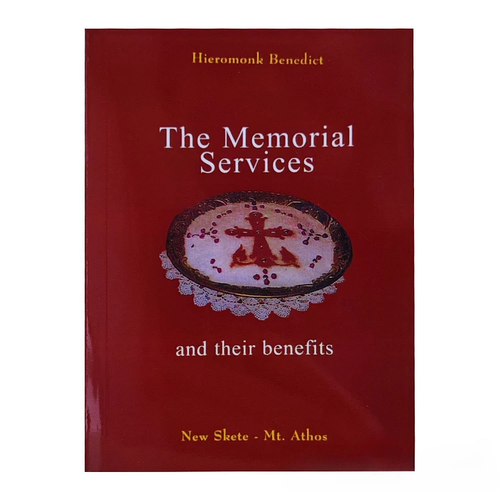
The Funeral Service, namely the Service of Brethren Fallen Asleep, is celebrated for all fallen asleep, Kings as well as Patriarchs, and Hierarchs and Priests, for men as well as women, young and old. According to the teaching of the Eastern Orthodox Church, death is nothing else but “Pascha,” the “passing over” (Christian Passover) from this perishable life unto eternal life. Therefore, we also call it the dormition, the repose or the falling asleep of a brother or sister. Indeed, the burial site we refer to as a cemetery derives its name from the Greek word “κοιμητήριον” (κοίμησις = falling asleep). The Eastern Orthodox Church funeral service is full of symbolism and references to both the Old and New Testaments. The rich burial preparation rituals and folk traditions that surround it enhance its spiritual depth and beauty. The Funeral Service is divided into three parts. “The Trisagion” comprises the first part and is read in the house of the deceased (or in the modern era, most often at the funeral home) from where, upon dismissal, the Priest escorts the deceased to the second part in the church proper, where the “Service of Brethren Fallen Asleep” is celebrated. The third and final part is “The Entombment” at the cemetery.
ACKNOWLEDGMENTS
This endeavor, a personal pledge and promise to my teachers and students, was a team
effort completed in the spirit of mutual respect with a number of people who left me humbled
with their engagement. Editions and corrections, were offered by the following cantors and
choir directors, friends, students of the Psaltic Art, and long-time collaborators, whom I thank
with all my heart:
Nicholas Jones, PhD, cantor and choir director, Saint Mary’s Romanian Orthodox Church, Falls
Church, VA.
Stephen Esper, MD, cantor and choir director of Saint George Antiochian Orthodox Church in
Pittsburgh, PA.
Rev. Fr. Panayiotis Steele, MDiv, ephemerios (second priest) of Saint Nektarios in Charlotte, NC.
Rev. Fr. Steven Zorzos, DMin, Presiding Priest of Saint Sophia Cathedral, Washington, DC, for
his review and revision of this work. Moreover, I thank him for his mentorship, his fatherly love,
his unwavering faith, and his jobian patience.
Rev. Fr. Stefanos Alexopoulos, PhD, Associate Professor of Liturgical Studies and Sacramental
Theology, School of Theology and Religious Studies, Catholic University of America,
Washington, DC, who graciously provided me additional sources necessary to accurately convey
the correct order of the services, and who patiently followed my work from its initial stages to
its completion.
Finally, I would like to thank the Rev. Fr. Romanos Karanos, PhD, Assistant Professor of
Byzantine Liturgical Music at Holy Cross Greek Orthodox School of Theology, Brookline, MA,
not only for his overall review of this effort, including musical, orthographical, and
typographical corrections, but also for extending his helping hand (and voice) to all of my
endeavors. Most especially, I thank him for his unwavering faith in the sacred cause of
disseminating the Psaltic Art throughout the world.
Georgios Theodoridis
Table of Contents
Prologue — i–vii
The Trisagion Service — 2–12
The Funeral Service
The Processional Hymns — 14–20
First Stanza — 22
Second Stanza — 28
Third Stanza — 34
Evlogetaria for the Departed — 38
Kontakion — 50
Funeral Idiomela — 54
Prokeimenon and Readings — 72
Farewell Hymns — 82
The Burial — 98
The Memorial Service — 100–124
Funeral Service during Renewal Week
Christ is Risen — 130
Ode 1–Ode 9 — 130–160
Exaposteilarion of Pascha — 160
Epistle and Gospel Readings — See Appendix
Doxastikon of Pascha — 166
Appendix of Readings during Bright Week — 172–198
Funeral Service for Infants
Order — 200–212
Farewell Hymns — 208
Old Processional Hymns (GR)
I Weep and with Tears Lament — 215
Theotokion — 228
Athenian Trisagion — 224